Long-Life Surfaces
Terrazzo and polished concrete can perform for 40 to 75 years with periodic resealing because they function more like part of the building than a replaceable surface layer.
For Phoenix facilities facing 110-degree summers, monsoon dust, and heavy daily traffic, durable flooring has to withstand heat, abrasion, rolling loads, and repeated cleaning-not just look tough. Phoenix Rubber Flooring evaluates commercial flooring choices across Maricopa County by traffic load, moisture exposure, slab condition, and maintenance needs. Polished concrete and terrazzo offer the longest service life, while epoxy and high-wear-rated LVT can be better fits for specific environments.
Terrazzo and polished concrete can perform for 40 to 75 years with periodic resealing because they function more like part of the building than a replaceable surface layer.
Epoxy suits forklifts and chemical exposure, while high-wear LVT works well where constant foot traffic, appearance, and easier finish changes matter.
Check moisture-vapor readings, substrate condition, traffic type, slip-resistance needs, and maintenance capacity before choosing a flooring material.
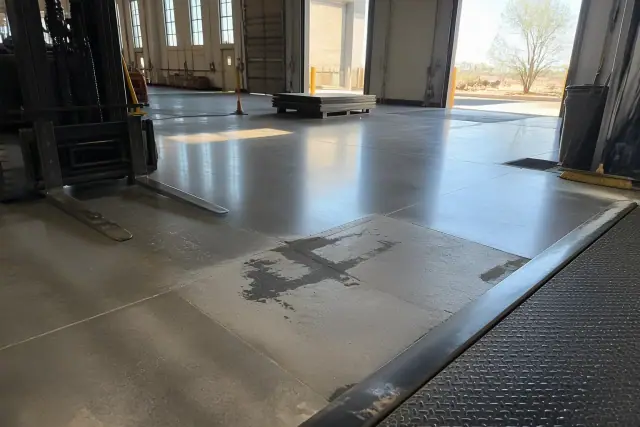
A prepared warehouse slab carrying forklift and pallet-jack loads. This image helps make rolling-load durability and joint condition easy to compare.
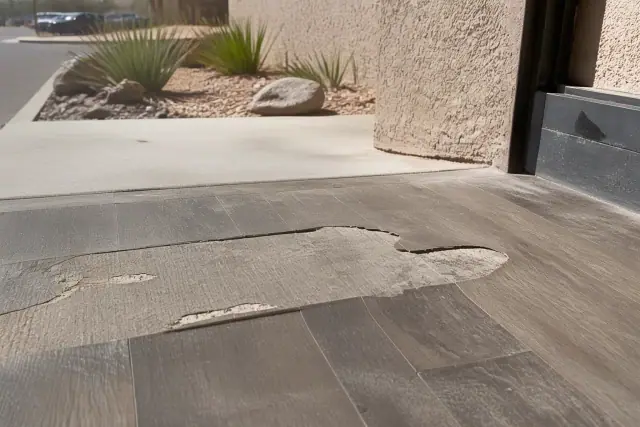
The wear layer, glue-down installation, and direct sunlight through storefront glass. These details affect abrasion resistance, dimensional stability, and fading in Phoenix heat.
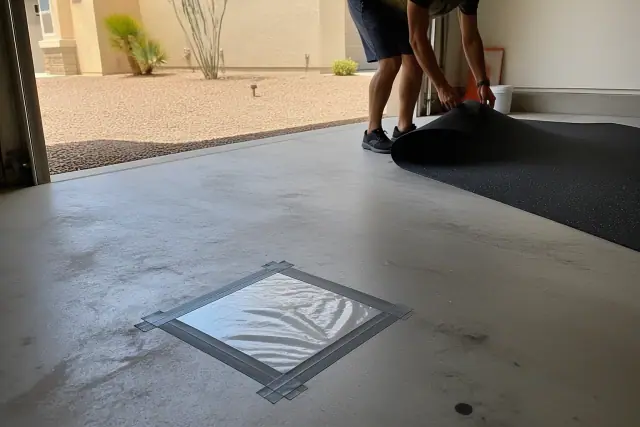
A slab-moisture test before coating or glue-down flooring is installed. Caliche soil and irrigation patterns can create higher-than-expected readings in older industrial buildings.
Terrazzo and polished concrete lead on lifespan, while commercial porcelain tile can exceed 25 years when the assembly and installation suit the space.
Look for at least a 20-mil wear layer, an AC4 or AC5 abrasion class, and ASTM F1700 compliance; glue-down installation adds stability under carts and equipment.
Epoxy and polyaspartic coatings over properly prepared concrete resist abrasion, chemical staining, forklifts, and constant loading in manufacturing and distribution settings.
VCT needs routine strip-and-wax care, while polished concrete and terrazzo need resealing every 1-3 years depending on traffic; missed maintenance can shorten any rated lifespan.
| Flooring | Best-Fit Commercial Use | Durability Signal | Maintenance or Cost Factor |
|---|---|---|---|
| Terrazzo or polished concrete | Warehouses, lobbies, and public corridors | Often 40 to 75 years | Periodic resealing, commonly every 1-3 years |
| Commercial vinyl | Retail, offices, and healthcare | Typically 10 to 20 years | Vinyl products generally run $2.50-$4.50 per square foot installed |
| Epoxy or polyaspartic coating | Forklift traffic and chemical exposure | High abrasion and chemical resistance | Requires concrete preparation and slab-moisture testing |
| Commercial porcelain tile | Kitchens and grit-exposed entries | Can exceed 25 years | Confirm slip resistance for the application |
| Carpet or carpet tile | Offices needing acoustic comfort | Usually 5 to 15 years; institutional facilities often average 8 to 10 | Shorter replacement cycle than hard surfaces |
There is no single winner for every facility: terrazzo and polished concrete lead in raw lifespan, epoxy handles severe industrial exposure, and commercial LVT balances wear resistance with design flexibility. Terrazzo becomes more cost-efficient at 2,500 square feet or more, while smaller spaces may get better lifecycle value from another material. Compare expected years of use, maintenance labor, substrate preparation, and replacement disruption-not purchase price alone.
Traffic type-foot, cart, pallet jack, or forklift-matters as much as traffic volume, which can reach thousands of cycles per day. Slab moisture, chemical exposure, direct UV through storefront glass, ADA slip resistance, acoustic needs, and the cleaning program can all change the best material. Use measurable specifications such as ASTM F970 static-load resistance, ASTM F1700 vinyl performance, ANSI A137.1 porcelain-tile requirements, and applicable NFPA 101 life-safety needs instead of judging durability by appearance alone.
How long does commercial vinyl last? LVT, VCT, and sheet vinyl generally serve for 10 to 20 years with appropriate maintenance. Which surface works best in Arizona heat? Polished concrete, porcelain tile, and UV-stable LVT tolerate sustained heat and storefront glare, but ground-floor choices should still follow slab-moisture readings. What about healthcare or restaurant spaces? Moisture-resistant sheet vinyl, seamless epoxy, or commercially rated porcelain can address cleaning, spill, and infection-control needs when their slip and life-safety requirements match the application.
Share the space type, daily traffic, slab condition, cleaning demands, and budget. A commercial flooring assessment can compare materials against those conditions before installation.