Proudly serving Phoenix, Mesa, Chandler, Scottsdale, Gilbert, Tempe & surrounding areasCall or Text 24/7: +1 (480) 916-7433

Basement Rubber Flooring Installation in Phoenix, AZ with Moisture Testing and Subfloor Prep

Phoenix Rubber Flooring installs basement rubber flooring in Phoenix, Arizona, with each surface selected for the slab, room use, and budget. Our work includes interlocking rubber tile, rubber rolls, poured-in-place surfaces, and home gym flooring, along with moisture barriers and concrete sealing when test results call for them. We test slabs with ASTM F2170 relative humidity probes and ASTM F1869 calcium chloride testing, then prepare the concrete to ASTM F710 standards. The result is a flooring plan built around the basement's actual moisture and traffic conditions.

Phoenix basements can face monsoon runoff, low-lying groundwater pressure, and condensation created by a 25-40 degree temperature swing between a cooled lower level and 110-plus-degree summer days. Rubber resists water, but it cannot correct a drainage problem or protect an unprepared slab by itself. We assess the slab, flag grading or downspout concerns, and match the adhesive, sealer, and vapor barrier to measured conditions. That preparation helps prevent bubbling, curling edges, adhesive breakdown, and trapped moisture.

Our installers hold Certified Flooring Installer (CFI) credentials, and Phoenix Rubber Flooring carries Arizona Registrar of Contractors licensing for the work we perform. Correctly installed rubber flooring on a Phoenix basement slab can hold up 15-25 years, depending on the system, slab conditions, and use.

Phoenix Rubber Flooring provides basement rubber flooring installation in Phoenix and the surrounding Valley, including Scottsdale, Tempe, Mesa, Glendale, and Chandler.

★ ★ ★ ★ ★4.9/5 Average Rating · 20+ Years of Experience · Thousands of Customers Helped · Licensed & Insured · Residential & Commercial

Basement Rubber Flooring Options & Benefits

What Is Basement Rubber Flooring?

Basement rubber flooring is a resilient surface installed as interlocking tiles, adhered rolls, or a poured-in-place layer over prepared concrete. The format is chosen around the room's shape, moisture readings, foot traffic, impact load, appearance, and budget.

Rubber is naturally water-resistant and does not warp, swell, or delaminate the way laminate or hardwood can when moisture reaches it. It is not a substitute for drainage correction, slab sealing, or a vapor barrier when testing shows moisture moving through the concrete.

Rubber itself is not an organic food source for mold, but dampness trapped beneath poorly sealed seams or an unprotected adhesive layer can still support growth on other material. Testing and moisture control beneath the floor are therefore as important as the finished surface.

Benefits of Basement Rubber Flooring

A properly specified rubber floor can make a Phoenix basement more durable, easier to use, and better suited to moisture-prone conditions. The key advantages depend on pairing the right product with disciplined slab preparation.

  • Water-resistant material that will not warp or swell like wood or laminate
  • Impact absorption for home gyms, strength training, and active rooms
  • Replaceable individual sections when interlocking tile is used
  • Fewer seams across large rectangular rooms when rubber rolls are installed
  • A seamless finish with poured-in-place EPDM rubber and polyurethane binder
  • Solid-tone and color-flecked options for a more finished basement
  • Recycled rubber choices made largely from reclaimed tire material
  • A typical 15-25-year service life when the floor is prepared and installed correctly
Basement Flooring Services

Rubber Flooring Installation Services

Phoenix Rubber Flooring handles the slab preparation, moisture control, material selection, layout, and finish work required for basement and gym floors. Each service below addresses a different part of building a surface that fits the room and its conditions.

Basement Rubber Flooring Installation

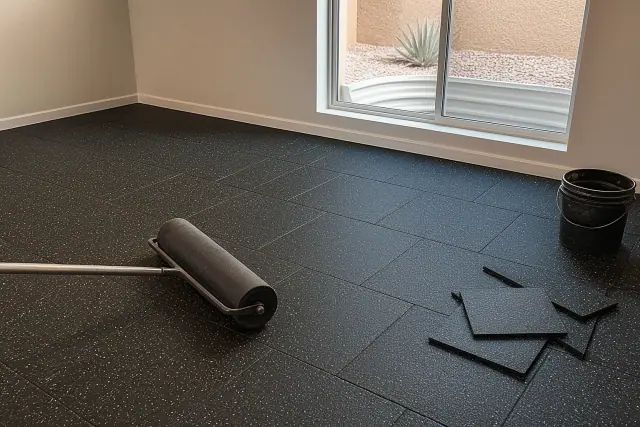
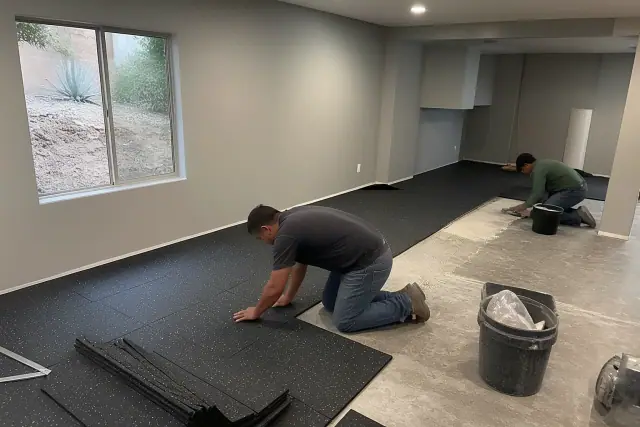
Rubber flooring installation on a concrete basement floor in Phoenix, AZ, showing seams and tools.

We match basement flooring to the concrete condition, room layout, expected traffic, and moisture profile. Installation may use interlocking tile, adhered rolls, or a seamless poured surface after the slab is tested and prepared.

Request Estimate

Moisture Barriers and Concrete Sealing

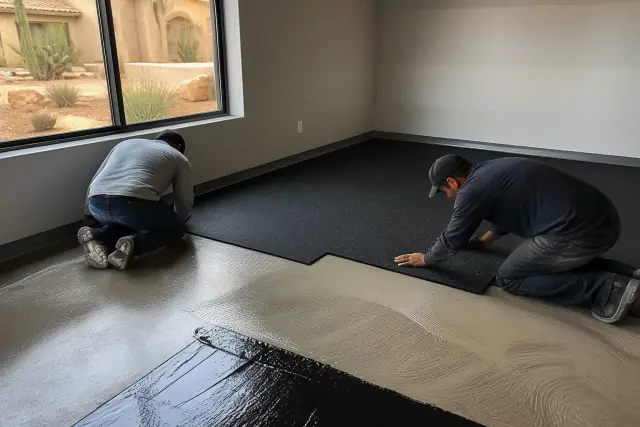
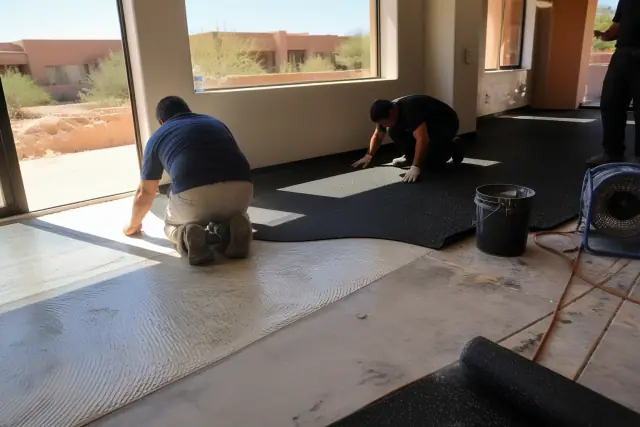
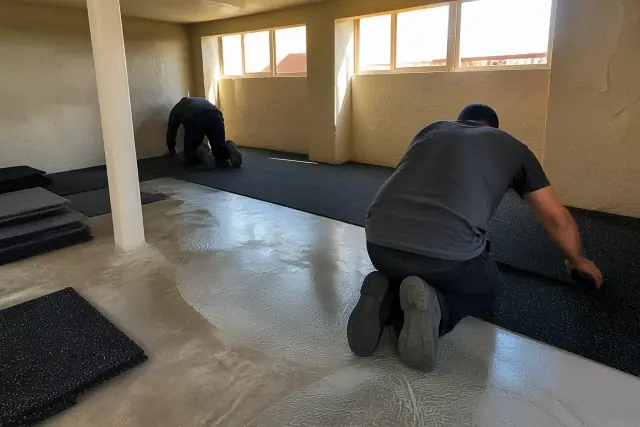
Crew members installing rubber flooring over a moisture barrier in a Phoenix, AZ basement.

For slabs with seasonal dampness or elevated test readings, we can combine penetrating concrete sealer with a polyethylene, epoxy-based, or polyurethane vapor barrier. The barrier is selected before adhesive or flooring is placed so moisture is managed at the slab rather than trapped beneath the surface.

Request Estimate

Interlocking Rubber Tile Installation

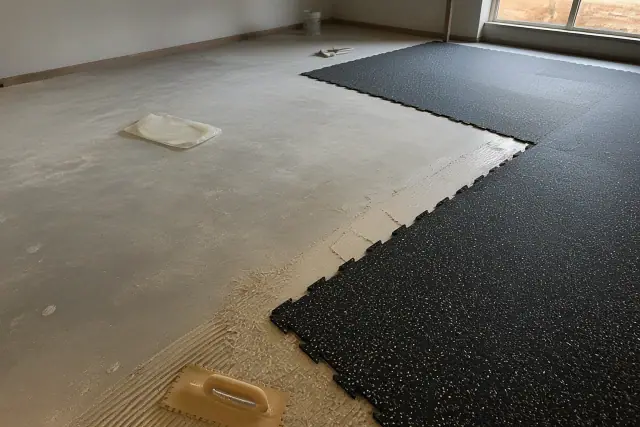
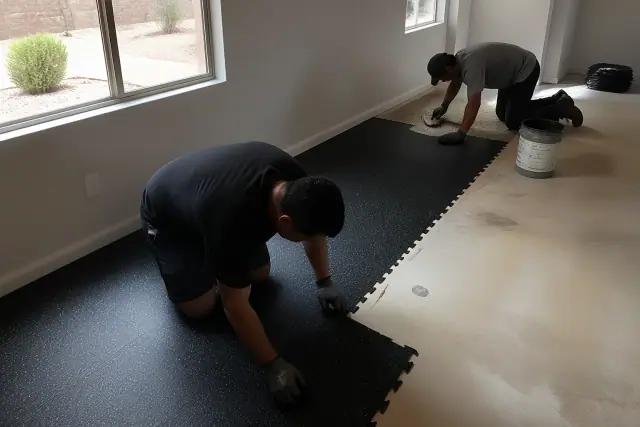
Contractor installing interlocking rubber floor tiles on a concrete basement floor in Phoenix, AZ.

Interlocking tiles work well around columns and irregular walls because they can be dry-laid, trimmed at the perimeter, and replaced individually if damaged. Most residential layouts do not require adhesive, which also makes the system suitable where a permanent bond is not wanted.

Request Estimate

Rubber Roll Flooring Installation

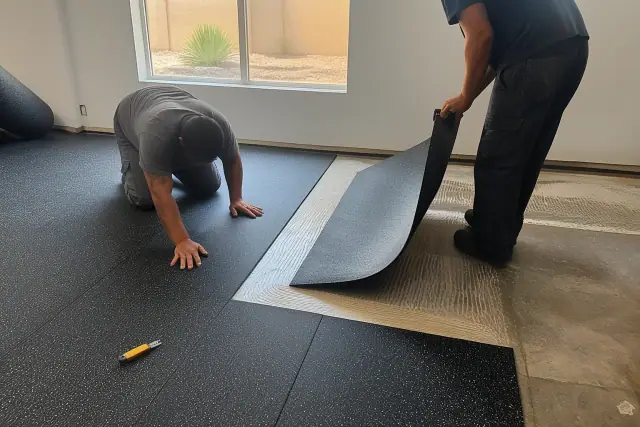
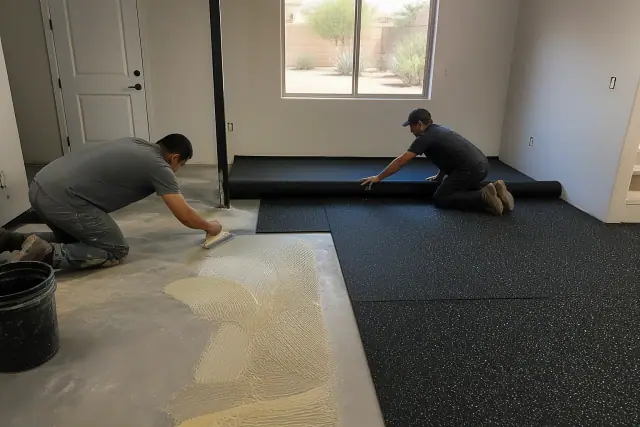
Crew members installing rubber roll flooring on a concrete basement floor in Phoenix, AZ.

Rubber rolls cover large rectangular rooms with fewer seams than tile. We prepare the slab, select adhesive for the measured vapor emission rate, fully bond the material, and seam-roll it for a tight fit.

Request Estimate

Poured-in-Place Rubber Flooring

Workers installing poured-in-place rubber flooring in a Phoenix, AZ basement.

Poured-in-place rubber combines EPDM granules with polyurethane binder and is troweled directly over the prepared slab. The cured surface has no tile edges or roll seams where moisture and dirt can collect.

Request Estimate

Home Gym and Commercial Rubber Flooring

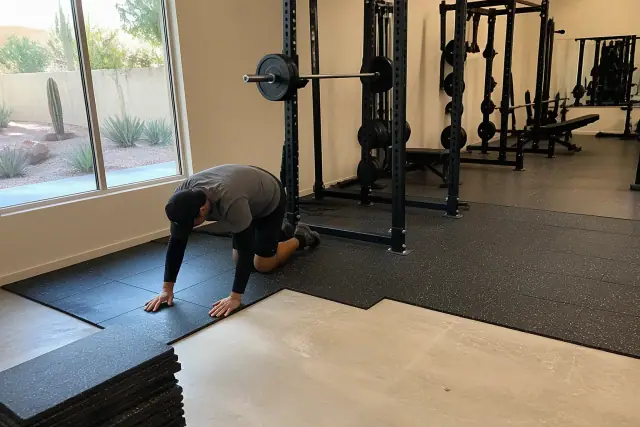
Technician installing rubber gym flooring over a concrete basement slab in Phoenix, AZ.

We install rubber surfaces for basement gyms, strength-training areas, commercial gyms, training facilities, and healthcare spaces across the Phoenix metro. Product density, impact control, slip resistance, and applicable accessibility needs are evaluated for the intended use.

Request Estimate
Material and Format Choices

Types of Basement Rubber Flooring Options

Tile, roll, poured, recycled, and heavy-duty gym rubber each solve a different mix of layout, moisture, impact, appearance, and budget needs. Moisture readings and concrete condition come first; the finished format is chosen after those conditions are understood.

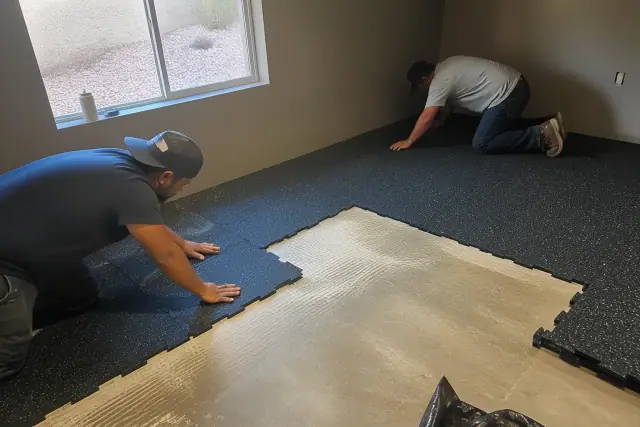
Crew members installing interlocking rubber flooring tiles in a residential basement in Phoenix, AZ.

Interlocking Rubber Tiles

Interlocking tile is flexible for basements with columns, offsets, rental restrictions, or zones that may need future repair. We dry-lay the pattern, work from the center outward, and trim perimeter pieces to the walls and supports.

  • Installs without adhesive in most residential applications
  • Allows a damaged tile to be lifted and replaced
  • Uses 3/8-inch to 1/2-inch tile for many basement home gyms
  • Adapts to irregular rooms, columns, and border cuts
  • Can support a temporary or non-permanent basement layout
Request Estimate
Contractors installing rolled rubber flooring in a Phoenix, AZ basement.

Rolled Rubber Flooring

Rolled rubber is efficient for broad, rectangular basement areas where minimizing seams is important. The material is fully bonded to a mechanically prepared slab and rolled at the seams to create a consistent surface.

  • Uses thinner 1/4-inch rubber for many living or media rooms
  • Creates fewer joints than an equivalent tile layout
  • Supports wall-to-wall installation or defined activity zones
  • Requires adhesive selected for the slab's measured emission rate
  • Available in solid-tone and color-flecked finishes
Request Estimate
Contractors installing poured-in-place rubber flooring in a Phoenix, AZ basement.

Poured-in-Place Rubber

EPDM rubber granules and polyurethane binder are mixed, troweled over the prepared slab, and allowed to cure for 24-48 hours depending on temperature and humidity. The finished surface is seamless and especially useful where moisture management and easy cleaning are priorities.

  • Runs about $16 per square foot installed
  • Costs roughly $2,300 for a standard-size room
  • Can hold up 20 or more years under heavy residential or light commercial use
  • Eliminates tile edges and roll seams
  • Can be paired with shock-absorbing underlayment below finished living space
Request Estimate
Contractors installing recycled rubber flooring on a concrete basement floor in Phoenix, AZ.

Recycled Rubber Flooring

Recycled rubber tile and roll products are built largely from reclaimed tire rubber, offering a durable, budget-conscious surface without giving up moisture resistance. Product selection can include post-consumer content for projects pursuing material documentation.

  • Available in both tile and roll formats
  • Handles basement foot traffic and gym use
  • Retains the water-resistant qualities of rubber
  • May support LEED material credit documentation on qualifying projects
  • Includes heavy-gauge choices for repeated impact
Request Estimate
Contractors installing heavy-duty rubber flooring in a basement in Phoenix, AZ.

Heavy-Duty Gym Flooring

Gym flooring is sized by use because cardio equipment, free weights, and repeated Olympic lift drops place different loads on the surface. Residential and commercial projects can also require attention to sound transfer, accessibility, and slip resistance.

  • Uses less density where cardio equipment is the primary load
  • Adds impact protection for free-weight and barbell areas
  • Uses 3/4-inch to 1-inch heavy-duty rubber for CrossFit-style training
  • Can include shock-absorbing underlayment to reduce noise transfer upstairs
  • Accounts for ADA needs and ANSI/NFSI B101.3 slip-resistance requirements on commercial work
Request Estimate
Finding the Right Fit

Choosing the Right Basement Flooring Approach

The best choice depends on moisture readings, slab flatness, room shape, impact load, desired appearance, permanence, and budget. Interlocking tile favors flexibility, rolls reduce seams across larger rectangles, and poured rubber creates a seamless finish; testing determines what preparation must come before any of them.

ASTM Moisture Testing

Every slab is checked with ASTM F2170 relative humidity probes and ASTM F1869 calcium chloride vapor-emission testing. When F2170 readings rise above 75% relative humidity, we specify a full epoxy or polyurethane vapor barrier instead of asking adhesive alone to manage the moisture.

Phoenix Slab Expertise

Phoenix conditions can combine caliche or decomposed granite soil, slab temperatures above 100 degrees near exterior walls, and fast moisture during the July-to-September monsoon season. Experience with older slabs in Arcadia and Encanto and modern construction in Ahwatukee helps us evaluate each basement instead of applying a generic installation plan.

CFI-Credentialed Installation

Our installers hold Certified Flooring Installer credentials, and we carry Arizona Registrar of Contractors licensing for the work we perform. We use products from established rubber flooring manufacturers and complete preparation, adhesive selection, and seam work around the requirements for the selected system.

Built for Phoenix Basements

Why Choose Phoenix Rubber Flooring for Basement Installation?

A basement floor performs only as well as the slab assessment beneath it. Phoenix Rubber Flooring combines measured moisture data, mechanical concrete preparation, appropriate vapor control, and a flooring format selected for the space rather than treating rubber as a one-size-fits-all moisture fix.

Request an Assessment

Moisture Vapor in the Slab

Vapor moving through concrete can weaken adhesive and collect under the finished floor. We use a rated moisture barrier when emissions exceed 3 lbs per 1,000 square feet per 24 hours, the point where most adhesive manufacturers begin voiding warranties.

Adhesive Breakdown

High moisture, the wrong adhesive, or an alkaline slab can break the bond beneath rubber tile or rolls. Concrete with a surface pH above 10 can degrade certain adhesives, so pH is tested and neutralized where needed before installation.

Bubbling and Curling Edges

Bubbles, raised seams, and curling edges commonly trace back to skipped moisture testing, inadequate mechanical preparation, or poor seam rolling. A floor installed without those controls can fail within the first two years instead of delivering its expected service life.

Monsoon Drainage Pressure

During monsoon season, poor grading, ineffective gutter drainage, or hydrostatic pressure can push water toward basement walls and slabs. Flooring cannot repair an exterior drainage defect, so we flag visible grade and downspout concerns before the floor is covered.

Uneven or Damaged Concrete

Laitance, old adhesive, cracks, spalling, and uneven areas keep rubber from lying flat and bonding consistently. We grind or shot-blast the surface, make repairs, and confirm flatness within 3/16 inch over a 10-foot span.

Trapped Moisture and Mold Risk

Rubber does not feed mold, but trapped dampness, stagnant air, and organic debris beneath an improperly sealed floor can create conditions for growth. Slab testing, sealed seams, and a vapor barrier where readings warrant it address the moisture before the finish is installed.

How It Works

Our Basement Rubber Flooring Process

The work follows a deliberate sequence from slab evaluation through final inspection. Each step confirms that the concrete, moisture-control layer, and selected rubber format are ready for the next stage.

01.

Slab and Room Assessment

We walk the basement, review how the room will be used, inspect the slab, and note drainage, grading, downspout, crack, and spalling concerns that could affect the installation.

02.

Moisture and pH Testing

ASTM F2170 probes, ASTM F1869 calcium chloride testing, and surface pH checks establish whether the slab is ready for adhesive or needs additional moisture and alkalinity control.

03.

Mechanical Concrete Preparation

We grind or shot-blast the concrete to remove laitance and old adhesive residue, repair cracks and spalling, and verify the flat surface required by the flooring manufacturer.

04.

Sealing and Vapor Control

Where test results indicate elevated moisture, we seal the concrete and install a compatible polyethylene, epoxy-based, or polyurethane vapor barrier before adhesive or rubber touches the slab.

05.

Layout and Flooring Installation

We plan seams and border cuts, then interlock tile, fully bond rubber rolls, or trowel the poured-in-place EPDM and binder system according to the chosen material and room layout.

06.

Seam Rolling and Final Walk-Through

Adhered surfaces receive proper seam rolling, perimeter work is checked, and the finished floor is reviewed in a final walk-through after the installation or required curing stage is complete.

Plan Your Basement Floor

Schedule a Basement Flooring Assessment

Call Phoenix Rubber Flooring to schedule a basement walk-through, slab moisture testing, and a clear recommendation for tile, roll, or poured rubber. Your estimate can account for concrete preparation, vapor control, intended use, and the product selected for the room.

Basement Flooring Help

Basement Rubber Flooring FAQs

These answers cover cost, moisture control, installation methods, material choices, and service life for basement rubber flooring in Phoenix. Testing the actual slab is still the best way to determine which preparation and product fit a specific room.

Call Our Installers

Rubber tile flooring averages around $10 per square foot total, with installation labor alone running about $2 per square foot. A typical 144-square-foot basement room falls between $800 and $1,500 for tile installation, while tile or roll projects can range from $8-$18 per square foot installed. Poured-in-place rubber runs about $16 per square foot, or roughly $2,300 for a standard-size room. Final pricing depends on slab condition, moisture-barrier needs, and product selection.

Yes. Rubber is water-resistant, does not warp or swell like wood or laminate, and provides a slip-resistant, impact-absorbing surface. Proper slab testing and moisture control are still necessary because the flooring alone does not stop vapor moving through concrete or correct drainage problems.

Rubber itself is not an organic food source for mold. Growth can still develop on trapped debris or other material when dampness and stagnant air remain beneath a poorly sealed floor. ASTM F1869 or F2170 testing and a vapor barrier where readings warrant it are the main defenses against that condition.

Rubber generally costs more upfront than basic vinyl or laminate, and some products can have a noticeable odor for the first several days after installation. It is heavy, poured and fully adhered formats are not especially DIY-friendly, and available colors and patterns are more limited than some basement flooring choices.

That depends on the slab's measured moisture. When ASTM F2170 testing is above roughly 75% relative humidity, or ASTM F1869 testing shows elevated vapor emission, we recommend a full compatible barrier rather than relying on adhesive alone. Older slabs without modern vapor retarders and basements near washes are more likely to need that protection.

Labor for rubber tile typically runs around $2 per square foot, while total installed tile or roll costs generally range from $8-$18 per square foot depending on product and preparation. Poured-in-place work is usually higher because it requires mixing, troweling, and curing. Concrete preparation, moisture testing, and vapor-barrier work should be accounted for separately when required.

Installation starts with moisture testing and mechanical concrete preparation, followed by sealing or a vapor barrier where readings require it. Tile can be interlocked or glued down, rolls are fully bonded and seam-rolled, and poured rubber is troweled directly over the prepared slab. Every method depends on sound concrete preparation.

Rubber flooring installed correctly on a Phoenix basement slab can hold up 15-25 years. Poured-in-place rubber can last 20 or more years under heavy residential or light commercial use. Slab moisture, preparation quality, traffic, and product type all affect service life.

Interlocking tiles work well in irregular rooms and around columns, and individual pieces can be replaced later. Rolls install efficiently in large rectangular rooms and create fewer seams. Basements used as home gyms often use 3/8-inch to 1/2-inch tile, while living or media rooms may use thinner 1/4-inch rolled rubber.

Poured-in-place rubber typically cures over 24-48 hours, or about one to two days, depending on temperature and humidity. The EPDM granules and polyurethane binder need that curing period to form the finished seamless surface.

The slab should be moisture- and pH-tested, mechanically ground or shot-blasted, and cleared of laitance and old adhesive residue. Cracks and spalling are repaired, and flatness is checked within 3/16 inch over a 10-foot span. Sealer or a vapor barrier is added when the readings call for it.

The intended exercise load determines thickness. Cardio equipment needs less density, while many home gyms use 3/8-inch to 1/2-inch tile. CrossFit-style or repeated Olympic-lift areas can require 3/4-inch to 1-inch heavy-duty rubber, sometimes over shock-absorbing underlayment.

Phoenix Rubber Flooring installs basement and gym rubber flooring throughout Phoenix and the surrounding Valley. The service area named in the source includes Scottsdale, Tempe, Mesa, Glendale, and Chandler.