Proudly serving Phoenix, Mesa, Chandler, Scottsdale, Gilbert, Tempe & surrounding areasCall or Text 24/7: +1 (480) 916-7433

Commercial Rubber Flooring Installation in Phoenix, AZ for Fitness Centers, Schools, and Warehouses

Phoenix Rubber Flooring installs commercial rubber flooring for Phoenix gyms, fitness centers, CrossFit boxes, dance studios, healthcare facilities, schools, and warehouses. We install rolled rubber, poured-in-place rubber, interlocking tile, and targeted matting for commercial and athletic spaces. Our material options include EPDM, SBR, recycled rubber, black rubber, and colored surfaces. Each project is planned around the facility's equipment, traffic, moisture, and use zones.

Phoenix's exposed concrete can reach temperatures past 140 degrees, while monsoon humidity and dry winter air create demanding slab conditions. Moisture vapor, thermal movement, and incomplete substrate preparation can weaken adhesive bonds or lift seams. We test moisture emission per ASTM F710 before adhesive installation and prepare the slab with grinding or shot-blasting when required. That climate-aware process helps the selected floor protect the slab, equipment, and people using the facility.

Phoenix Rubber Flooring holds an active Arizona Registrar of Contractors license, handles applicable City of Phoenix Development Services Department permits, and builds relevant athletic and commercial installations around ASTM F2772 and ASTM E648 performance requirements.

Phoenix Rubber Flooring installs commercial rubber flooring in Phoenix and throughout Scottsdale, Tempe, Mesa, Chandler, Glendale, and the broader Salt River Valley metro area.

★ ★ ★ ★ ★4.9/5 Average Rating · 20+ Years of Experience · Thousands of Customers Helped · Licensed & Insured · Residential & Commercial

Commercial Rubber Flooring Options & Benefits

What Is Commercial Rubber Flooring?

Commercial rubber flooring is a resilient surface built for the impact, traffic, cleaning cycles, and equipment loads found in gyms, institutions, and industrial facilities. It can be installed as continuous rolls, replaceable interlocking tiles, poured-in-place material, or focused protection mats.

The surface cushions dropped weights and repeated athletic movement while helping protect the concrete beneath it. Commercial-grade rubber also resists gouging from dumbbells, rack feet, and rolling equipment more effectively than light residential mats.

With correct material selection, substrate preparation, installation, and maintenance, rubber flooring can last 20 years or more. Its useful life and low-maintenance surface make it a practical alternative to products that require recurring wax, recoating, or refinishing.

Benefits of Commercial Rubber Flooring

Rubber flooring combines impact control, traction, durability, and straightforward upkeep in one commercial surface. The format, compound, density, and thickness can be adjusted by use zone so a facility does not rely on one generic specification.

  • Cushions dropped weights, jumps, and repeated athletic movement
  • Protects concrete from concentrated equipment and impact loads
  • Resists gouging in high-traffic commercial environments
  • Cleans with standard commercial cleaners
  • Avoids the waxing and resealing cycles required by VCT
  • Allows replaceable tiles or localized repairs in damaged zones
  • Offers black, colored, and recycled-rubber material choices
  • Supports zone-specific traction, stability, and shock absorption
Commercial Flooring Services

Commercial Rubber Flooring Services

We plan rubber flooring around the activity, point loads, hygiene needs, traffic, and maintenance routine of each facility. That lets a weight room, dance studio, school, healthcare space, or warehouse receive a surface selected for how the room actually operates.

Gym and Fitness Center Flooring

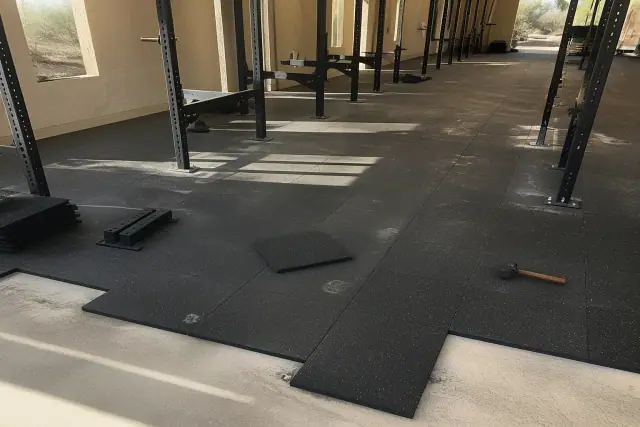
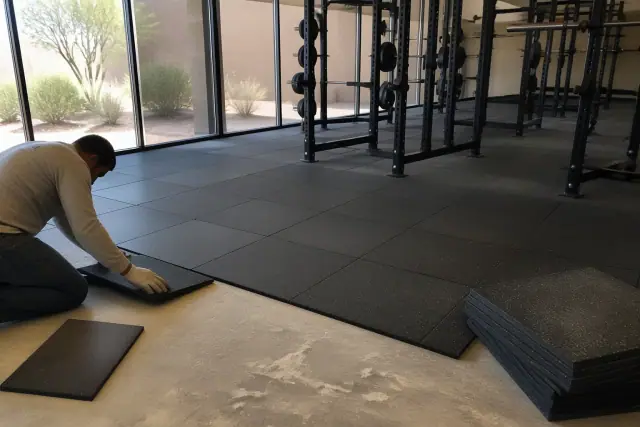
Technician installing heavy-duty rubber gym flooring onto a concrete slab in Phoenix, AZ.

Weight rooms commonly need 3/8-inch to 1-inch rolled rubber, depending on the equipment mix and dropped-weight loads. We size the surface to rack count, free-weight inventory, cardio equipment, and traffic instead of applying one thickness throughout the gym.

Request Estimate

CrossFit and Weight Room Flooring

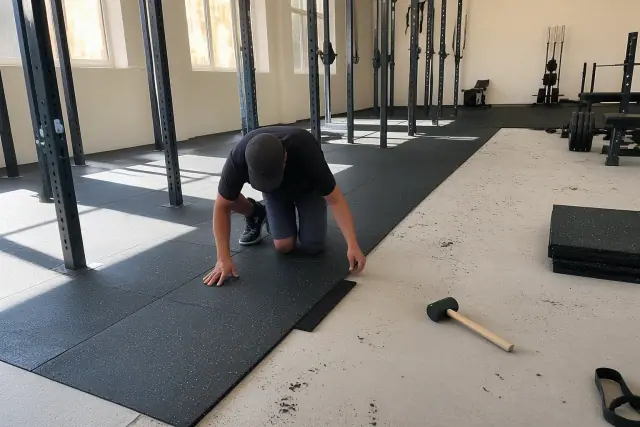
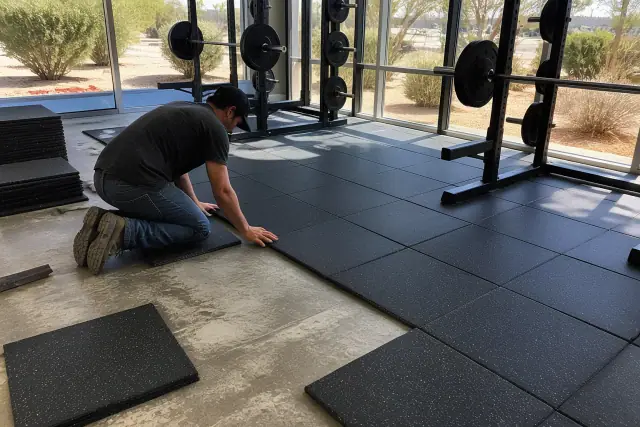
Contractor installing heavy-duty rubber gym flooring on a concrete slab at a fitness facility in Phoenix, AZ.

CrossFit boxes take daily Olympic lifting drops, so lifting platforms often call for 3/4-inch or greater rubber. A lighter gauge can cover open functional-training space, giving each zone the protection it needs without overspecifying the entire floor.

Request Estimate

Sports and Training Facility Flooring

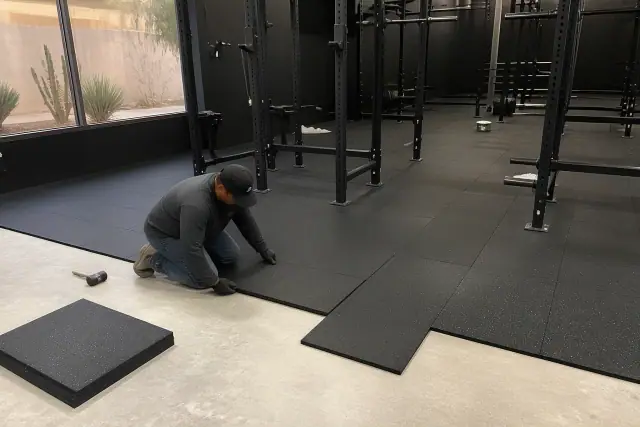
Technician installing heavy-duty rubber floor tiles in a Phoenix, AZ gym with squat racks.

Training facilities need traction and force reduction matched to the sport and training volume. We specify vulcanized rolled rubber or poured polyurethane-rubber composites as appropriate and document ASTM F2772 performance compliance on training-facility work.

Request Estimate

Dance Studio Flooring

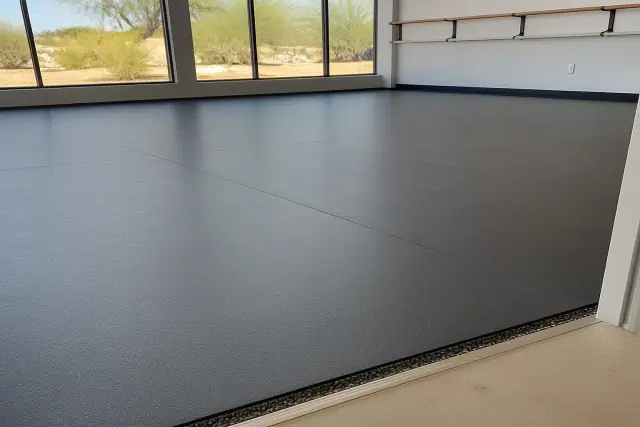
Commercial rubber dance studio flooring with acoustic underlayment installed in Phoenix, AZ.

Dance studios benefit from a resilient surface that provides traction and cushions repeated movement. Colored rubber can coordinate with a studio environment, while material density and thickness are selected for the room's activities rather than heavy lifting loads.

Request Estimate

Healthcare and School Flooring

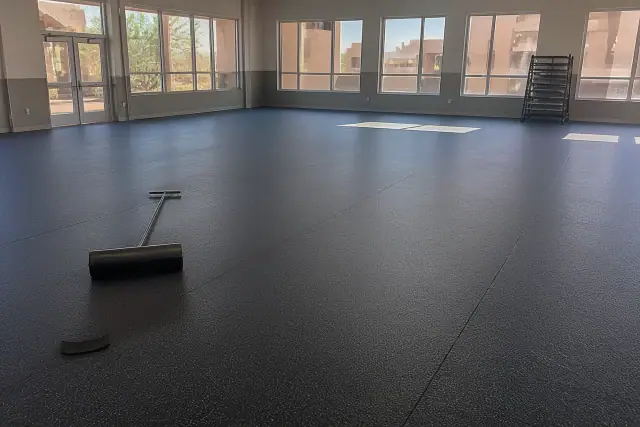
Newly installed rubber flooring in a school multipurpose room in Phoenix, AZ, showing seams and a floor roller.

Healthcare installations can use seamless or tightly sealed surfaces to limit bacterial harborage, with low-VOC rubber options supporting indoor-air-quality goals. Schools gain a durable surface for cafeteria spills, gym impacts, and daily custodial cleaning without a wax-based recoating schedule.

Request Estimate

Warehouse and Industrial Flooring

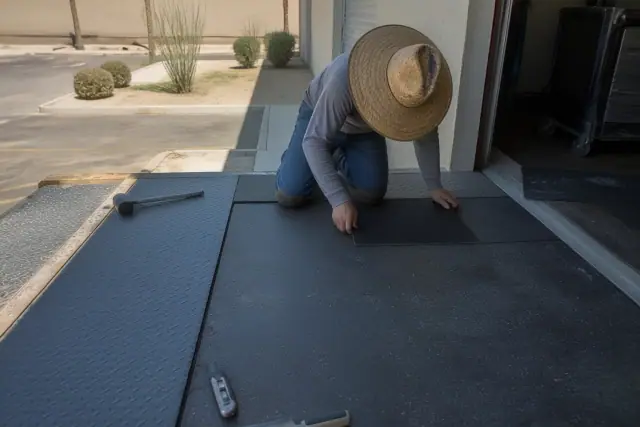
Contractor repairing industrial rubber flooring near a loading dock in Phoenix, AZ.

Warehouse rubber flooring is selected for forklift and pallet-jack traffic plus the oil and chemical exposure found in industrial bays. Full-floor rolled rubber, modular tile, or targeted mats can protect loading docks, equipment stations, and traffic lanes near Phoenix distribution corridors such as Sky Harbor.

Request Estimate
Material and Format Options

Types of Commercial Rubber Flooring Options

Format affects seam count, repairability, installation speed, hygiene, appearance, and cost. We compare the slab, room layout, traffic, equipment, and maintenance plan before recommending rolled rubber, interlocking tile, poured-in-place material, mats, or a combination.

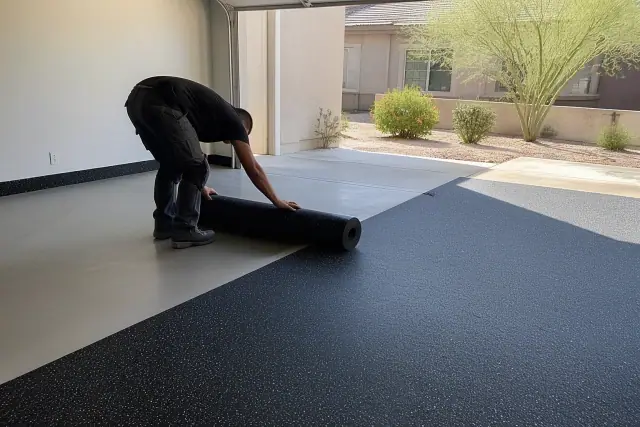
Worker unrolling sheets of recycled rubber flooring in a garage workshop in Phoenix, AZ.

Rolled Rubber Flooring

Rolled rubber creates long, continuous runs with fewer seams, making it a clean-looking choice for weight rooms, training rooms, and warehouse floors. It is especially practical for facilities over 3,000 square feet.

  • Fewer seams across large open rooms
  • Heavy gauges for free-weight and lifting zones
  • Lighter gauges for cardio and open training areas
  • Bonded installation over a prepared slab
  • Zone-by-zone thickness and density choices
Request Estimate
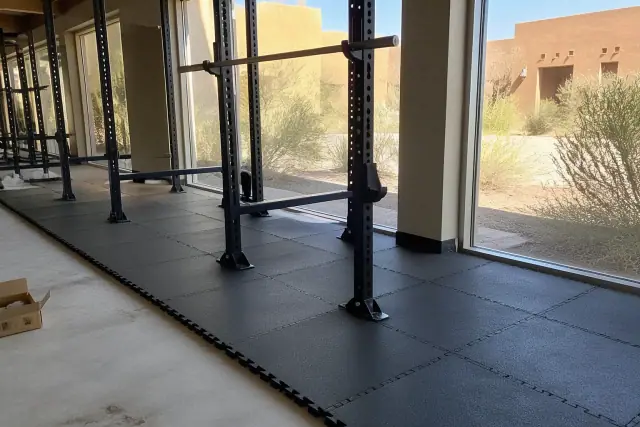
Interlocking rubber gym tiles installed around a squat rack in a fitness center in Phoenix, AZ.

Interlocking Rubber Tiles

Interlocking rubber tiles install without adhesive in many applications and can speed the flooring phase. If one area is damaged, individual tiles can be replaced without cutting into a continuous bonded floor.

  • Faster installation in many applications
  • Individual replacement of damaged sections
  • Stable surface for cardio equipment zones
  • Adhesive-free installation in many applications
  • Simplified access for future repairs
Request Estimate
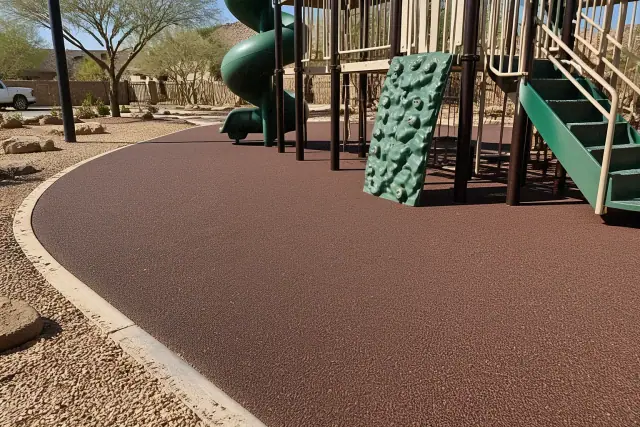
Technician-installed poured-in-place rubber flooring at an outdoor playground in Phoenix, AZ.

Poured-in-Place Rubber

Poured polyurethane-rubber composites create a seamless surface for specialty athletic, healthcare, and other applications where hygiene or custom color is important. The installation requires additional material blending and labor.

  • Seamless finish across the use area
  • Custom coloring for specialty spaces
  • Useful where tightly sealed surfaces matter
  • Polyurethane-rubber composite construction
  • Performance specified to the facility
Request Estimate
A technician installing heavy-duty rubber floor tiles in a commercial gym in Phoenix, AZ.

Commercial Rubber Mats

Commercial rubber mats provide focused protection where a full-floor installation is not needed. They can also be combined with rolled or tiled flooring to create a tiered protection plan.

  • Equipment-specific protection zones
  • Commercial entryway coverage
  • Loading-dock impact protection
  • Coverage without a full-floor installation
  • Flexible pairing with rolls or tiles
Request Estimate
Technician installing rubber floor tiles in a fitness center weight room in Phoenix, AZ.

Rubber Compounds and Colors

EPDM, SBR, and recycled-rubber compounds offer different combinations of density, appearance, and performance. Black rubber suits traditional gym environments, while colored rubber can fit studios, schools, and branded fitness spaces.

  • EPDM rubber options
  • SBR rubber options
  • Recycled-rubber content
  • Traditional black surfaces
  • Colored surfaces for studios and institutions
Request Estimate
Finding Your Right Fit

Choosing the Right Rubber Flooring Approach

The correct approach depends on point loads, slab condition, use zones, hygiene needs, and traffic rather than foot traffic alone. A squat rack carrying 800 pounds on four feet creates a different demand than an open cardio floor, so we compare the heaviest anticipated equipment with compound density, thickness, and format before specifying the surface.

Climate-Aware Slab Preparation

Arizona vapor drive and Phoenix thermal cycling make the concrete slab part of every flooring decision. Moisture testing, crack and joint inspection, pore-opening preparation, and mitigation when readings require it help prevent avoidable adhesive and lifting failures.

Permit and Performance Standards

Our active Arizona Registrar of Contractors license supports commercial project delivery, and we determine when City of Phoenix Development Services Department permitting applies. Athletic and flame-spread requirements are addressed through relevant ASTM F2772 and ASTM E648 performance criteria.

Facility-Specific Floor Specification

We size projects from a 2,000-square-foot studio near Camelback Corridor to full warehouse floors using load, moisture, and traffic data. Matching the material and gauge to each zone helps control cost while preserving protection where the facility needs it most.

What Sets Us Apart

Why Choose Phoenix Rubber Flooring for Commercial Installation?

Our process connects slab testing, facility loads, rubber format, thickness, compound, and adhesive selection before installation begins. We then check seam integrity, edge transitions, and adhesion before handoff, correcting any section that does not meet the project specification.

Request Site Assessment

Slab Moisture and Adhesive Failure

New pours, below-grade spaces, and slabs near irrigation or landscaping can emit enough moisture to compromise an adhesive bond even in an arid climate. ASTM F710 testing identifies when moisture mitigation or a vapor barrier is needed before rubber flooring goes down.

Thermal Cycling and Surface Movement

Extreme heat, monsoon humidity, and dry winter air make Phoenix slabs expand, contract, and release moisture at changing rates. A material and adhesive plan that ignores those conditions can lead to curling, weak bonds, or premature failure.

Impact Damage and Compression Set

Dropped dumbbells, rack feet, jump training, and rolling equipment concentrate force into small areas. Rubber that is too light or not dense enough can gouge or develop compression set, while properly specified material cushions impacts and protects the slab.

Dust and Monsoon Grit

Dust storms and monsoon grit track abrasive debris into Phoenix commercial entryways and activity areas. Rubber flooring supports routine cleaning with standard commercial cleaners and does not require the waxing or resealing schedule associated with VCT.

Seam Separation and Edge Curling

Lifted seams, curled doorway edges, and movement near expansion joints can indicate adhesive failure, moisture intrusion, or end-of-life wear. We trace the pattern to its cause before re-adhering seams, patching tiles, or replacing a worn rolled-rubber zone.

Wrong Thickness or Density

Thickness alone does not determine performance; compound density, equipment loads, and training volume matter too. A generic specification can leave free-weight zones underprotected or make low-impact areas more expensive than necessary.

How it works

Our Commercial Rubber Flooring Process

A durable commercial floor starts with the facility and slab, not the product catalog. Our process moves from site data and moisture testing through preparation, specification, installation, and a documented final walk.

01.

Facility Walk and Load Review

We review room size, rack count, free weights, rolling equipment, traffic paths, hygiene needs, and anticipated point loads. This establishes the use zones that drive the estimate and flooring specification.

02.

Moisture and Slab Inspection

We test slab moisture emission per ASTM F710 and inspect cracks, expansion joints, existing coatings, and cure condition. The findings show what preparation or mitigation the substrate needs before adhesive is applied.

03.

Surface Preparation and Mitigation

The slab is ground or shot-blasted as needed to open the pore structure and remove unsuitable coatings. When testing shows elevated moisture, we add the appropriate moisture-mitigation system or vapor barrier before flooring installation.

04.

Material and Zone Specification

We match rolled rubber, interlocking tile, poured-in-place material, or mats to each use zone. Thickness, density, compound, color, seam plan, and adhesive are selected around the facility's heaviest loads and operating needs.

05.

Professional Rubber Flooring Installation

Our crews lay out the selected floor, control seams and transitions, and use manufacturer-specified adhesive systems rated for Arizona conditions. Different gauges or formats can be integrated where the plan calls for tiered protection.

06.

Final Quality Walk

Before handoff, we inspect seam integrity, edge transitions, and adhesion throughout the project. Any area that does not meet the specification is corrected before the job is considered complete.

Plan Your Facility Floor

Schedule a Commercial Rubber Flooring
Consultation

Tell us about your facility, equipment, traffic, and current slab or flooring concerns. We provide a written commercial flooring estimate after a site walk so the scope reflects actual conditions rather than a generic average.

Commercial Flooring Help

Commercial Rubber Flooring FAQs

Get practical answers about vapor barriers, rubber flooring types, thickness, costs, maintenance, repairs, permits, and commercial applications in Phoenix.

Call Our Flooring Team

It depends on the slab's moisture-emission rate, which we test per ASTM F710 before commercial installation. New pours, below-grade spaces, and slabs near irrigation or landscaping can still emit enough moisture to weaken an adhesive bond in Phoenix. When readings are elevated, we install a moisture-mitigation system or vapor barrier before the rubber goes down.

Rubber is heavy, which can increase shipping and handling costs, especially for rolled goods. Some compounds have a noticeable initial odor that typically fades over several days to a few weeks with ventilation. Rubber also costs more upfront than VCT or basic vinyl, and some colors may fade slightly under prolonged direct UV exposure from large west-facing windows.

Rubber tile labor alone typically runs around $2 per square foot, while tile systems average near $10 per square foot installed. A 144-square-foot room generally falls between $800 and $1,500 total. Poured-in-place rubber is closer to $16 per square foot, or roughly $2,300 for a standard-size room, because it requires additional material blending and labor.

The three main formats are rolled rubber, interlocking tiles, and poured-in-place systems. Rolls minimize seams across large open areas, tiles allow individual replacement and faster installation in many applications, and poured-in-place rubber creates a seamless specialty surface. Commercial mats can also add targeted protection without covering the full floor.

Phoenix gym flooring generally ranges from roughly $7 to $16 per square foot installed, depending on thickness, compound, format, and slab preparation. Full commercial-grade projects across larger facilities can range from $45,000 to $220,000, while commercial-grade pre-cut rolled material alone often falls between $16,000 and $67,000 before labor, depending on coverage and gauge. A site walk produces a more useful estimate because equipment loads and slab conditions affect the scope.

Many commercial rubber products use recycled content, often reclaimed tire rubber, which diverts material from landfills. Recycled-rubber options also tend to qualify for low-VOC indoor-air-quality standards under FloorScore certification, which can matter on LEED-focused projects. A service life of 20 years or more can also reduce the replacement frequency associated with shorter-lived floors.

Most straightforward flooring replacements do not require a separate permit. Work involving substrate modification, moisture-mitigation systems, or a broader tenant improvement may fall under City of Phoenix Development Services Department review. As an active Arizona Registrar of Contractors license holder, Phoenix Rubber Flooring determines when a permit applies and handles the required filing.

With proper substrate preparation, installation, and maintenance, commercial rubber flooring can last 20 years or more. Traffic volume, compound density, and installation quality determine where a floor falls within that lifespan. Although rubber costs more upfront than some alternatives, avoiding repeated wax, recoat, and refinish cycles can narrow the total-cost gap significantly over a decade.

Standard commercial thickness ranges from 1/4 inch for light-use areas to 3/4 inch or thicker for free-weight and CrossFit zones. Weight rooms commonly use 3/8 inch to 1 inch depending on the equipment mix, and CrossFit lifting zones are often 3/4 inch or greater. Density and point loads matter alongside thickness, so the heaviest anticipated equipment should guide the choice.

Rolled rubber is usually the cleaner-looking choice for large open floors because continuous sheets reduce seam count. Interlocking tiles suit spaces where installation speed, modular layout, or individual replacement is important, and they need no adhesive in many applications. A facility can use both formats when free-weight, cardio, and traffic zones have different requirements.

Localized damage rarely requires a complete tear-out. Individual tiles can be patched or replaced, lifted seams can be re-adhered, and worn rolled-rubber zones can be replaced without disturbing the rest of the facility. Facility-wide wear or substrate-level failure may call for full replacement and renewed moisture testing.

Rubber flooring can be cleaned with standard commercial cleaners and does not require waxing or resealing like VCT. Routine removal of Phoenix dust and monsoon grit helps prevent abrasive debris from accumulating at entries and high-traffic areas. Maintenance should also include checks for lifted seams, curled edges, and wear beneath heavy equipment.

Commercial rubber flooring is used in gyms, CrossFit boxes, weight rooms, fitness centers, sports-training facilities, dance studios, healthcare spaces, schools, warehouses, loading docks, and equipment protection zones. The format and performance specification change with impact loads, traffic, hygiene, chemical exposure, and cleaning needs. A mixed-format design can serve several use zones within the same facility.