Typical Installed Range
Industry-wide, basic single-color poured rubber commonly runs $12-$18 per square foot installed. Custom colors or more durable safety-engineered construction can reach $20-$30+ per square foot.
For Phoenix-area projects, Phoenix Rubber Flooring uses a typical planning range of $8 to $18 per square foot for poured-in-place rubber, while customized or thicker impact-rated designs can reach $20 to $30+ per square foot. The installed total depends on square footage, substrate condition, depth, color pattern, fall height rating, and the drainage and heat conditions found at the site. An on-site assessment is more useful than a generic calculator because it accounts for base preparation, edge restraints, accessibility transitions, materials, and labor.
Industry-wide, basic single-color poured rubber commonly runs $12-$18 per square foot installed. Custom colors or more durable safety-engineered construction can reach $20-$30+ per square foot.
A 2.5-inch pour for a low fall-height structure costs less than a 4.5-inch system needed under a 10-foot deck. Color patterns, inlays, edge details, drainage, and base repairs can raise the total further.
Measure the play area and equipment fall heights, then inspect the existing concrete, asphalt, or loose-fill base. Site access, grading, drainage, and equipment protection should be documented before comparing estimates.
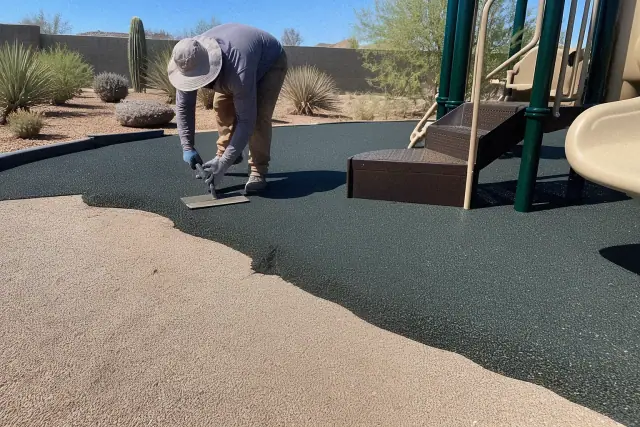
A graded, compacted aggregate base or suitable concrete pad with edge restraints and drainage. This context explains why caliche and monsoon runoff can change preparation costs.
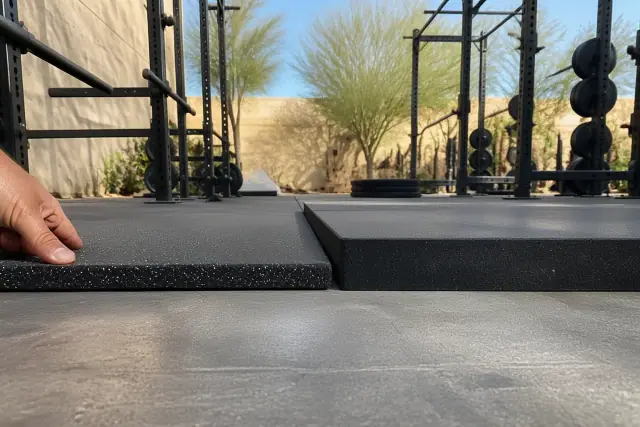
Side-by-side surface cross-sections beneath playground equipment. The deeper build beneath a 10-foot deck makes the fall-height cost difference visible.
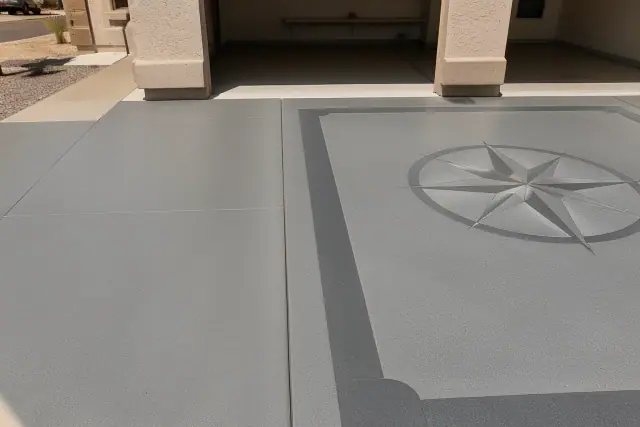
Compare a basic single-color play surface with a multi-color layout using borders and inlays. More complex patterns require added material handling and installation time.
Backyard surfaces of 200-600 square feet often total $2,400-$10,000 installed. Municipal or school playgrounds of 5,000+ square feet may benefit from volume pricing around $9-$15 per square foot.
For poured-rubber playgrounds of 1,000 square feet or more, expect roughly $9-$18 per square foot installed. Smaller surfaces may run $16-$25 per square foot because mobilization and setup costs are spread over less material.
Installation labor is roughly $1-$4 per square foot apart from material, or $15-$100 per hour depending on crew size, access, and complexity. A small area beneath a swing set may total $600-$2,000 installed, depending on material.
Correctly installed poured rubber typically lasts 10-15 years, with gradual hardening often appearing around years 10-12. Annual visual inspection, rinsing, and monsoon debris removal support planning for resurfacing around years 12-15.
| Surface Type | Typical Cost | Planning Context |
|---|---|---|
| Rubber mulch | $3-$6/sq ft material plus labor | Lowest-cost rubber option; loose fill needs periodic top-off. |
| Turf with padding | $3-$8/sq ft installed | Useful where play and shaded-use areas share a surface. |
| Basic poured rubber | $9-$18/sq ft installed | Seamless option for standard residential and commercial areas. |
| Rubber tile overlay | $10-$15/sq ft installed | Can reduce demolition when installed over suitable concrete. |
| Custom poured rubber | $20-$30+/sq ft installed | Reflects multi-color designs or thicker impact-rated construction. |
An installed quote should cover material, surface preparation, a base drainage layer, binder, a colored topcoat, and labor. A $10-per-square-foot national average may exclude grading, edge restraints, or ADA-compliant transitions that matter when caliche and monsoon runoff affect the base. A typical assembly uses compacted aggregate or existing concrete, a porous EPDM/SBR base layer, a colored EPDM wear layer, and urethane binder. In a full bid, base preparation often represents 10-20% of the total, aggregate and binder 25-35%, wear-layer material 30-40%, and labor 15-25%.
Critical fall height, surface area, base condition, access, color complexity, and demolition determine which range applies. Existing concrete or asphalt can reduce preparation, while removing pea gravel or wood fiber and regrading for drainage adds labor. ASTM F1292 impact attenuation and ASTM F1951 accessibility guide the specification; an 8-foot deck needs more shock-absorbing depth than a 4-foot deck. UV-stabilized EPDM also matters where Phoenix summer temperatures exceed 110°F for weeks, and installation scheduling must allow the urethane binder to cure correctly.
For the lowest upfront rubber cost, mulch starts around $3-$6 per square foot in material before labor, while bulk units are roughly $475-$650 at a 6-inch depth and require periodic top-off. For quantity planning, 2,000 pounds of rubber mulch covers about 150-180 square feet at a 3-inch depth or 120-140 square feet at a 4-inch depth; a 10% buffer accounts for grading and settling. Wood chips need annual replenishment, and engineered wood fiber generally needs replacement every few years in Phoenix's dry, UV-heavy climate. Poured-in-place rubber usually lasts 10-15 years with correct maintenance, but surfaces with improper binder ratios or cure time can fail in 5-7 years; commercial and municipal sites should plan inspections every 12 months.
Share the playground size, existing base, equipment fall heights, surface preference, and access details. A free on-site assessment can turn the broad planning ranges in this guide into an itemized estimate for preparation, materials, and installation.